
IPTV is a technology that transmits television content to your devices via the Internet Protocol, as opposed to traditional cable or satellite broadcasting, giving you access to thousands of channels on demand in high quality.
IPTV Nederland Vood is a specialized provider that uses powerful servers to deliver a stable and smooth stream, compatible with all modern devices such as smart TVs, smartphones, and tablets. Understanding how IPTV works helps you assess why this technology is becoming increasingly popular and how you can benefit from it to the fullest. In this guide, we explain step-by-step everything you need to know about IPTV in 2026, without jargon and in clear language.
What exactly does IPTV mean?
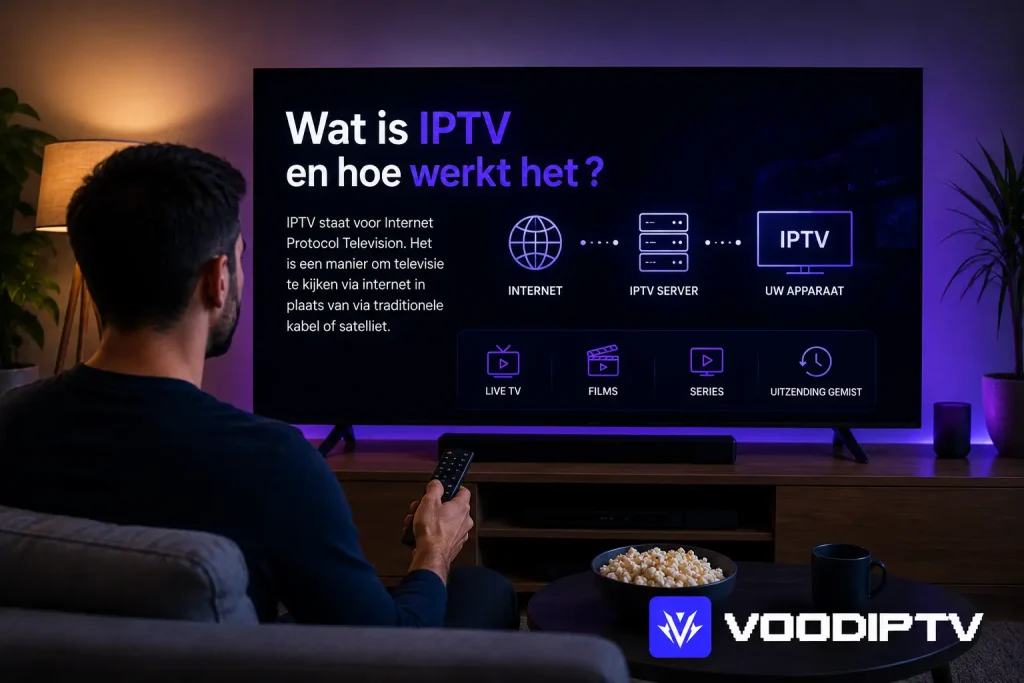
IPTV is an abbreviation for ” Internet Protocol Television “, a technology that transmits television content over the internet network instead of via traditional radio waves or cables. The main difference lies in the way the signal reaches the user: instead of a continuous broadcast, IPTV only sends the content that the viewer actually requests.
This interactive approach offers much more flexibility than classic television, with features such as live TV, replay, movies on demand, and the ability to pause or rewind. Moreover, IPTV uses the existing internet infrastructure, making it accessible even in areas without cable or satellite reception. Today, IPTV has become an increasingly common alternative to traditional television connections in the Netherlands.
How does IPTV work technically?
IPTV works by converting the television signal into data packets that are transmitted over the internet to your device via the IP protocol. When you select a channel, your IPTV application sends a request to the provider’s server, which immediately returns the requested video stream.
This stream is then decoded by your device and displayed on your screen in near real-time. The technology uses two key protocols: unicast for on-demand content (one stream per user) and multicast for live broadcasts (a stream shared by multiple users). Thanks to video compression techniques such as H.264 and H.265, the amount of transmitted data is minimized without loss of quality. This makes 4K broadcasting possible, even with reasonable internet connections.
What are the three types of IPTV services?
There are three main types of IPTV services, each with specific features that correspond to different viewing needs. Here is a comparative overview:
| Type IPTV | Description | Example of use |
| Live IPTV | Real-time broadcast of TV channels | Sports, news, live shows |
| Video on Demand (VOD) | Content available upon request | Films, series, documentaries |
| Time-shifted IPTV | Rewatch previously broadcast content | Replay, missed programs |
Live IPTV is particularly interesting for sports enthusiasts and news viewers who need instant access. VOD offers an extensive catalog of content that you can watch whenever you want.
Time-shifted IPTV combines the best of both by enabling you to watch recently broadcast programs without fixed time slots. A good provider integrates these three services into one unified interface.
How does IPTV differ from traditional TV?
IPTV differs from traditional TV primarily in the way the signal is transmitted and the interactivity offered to the user. Classic television broadcasts signals simultaneously to all receivers, regardless of whether anyone is watching or not. IPTV, on the other hand, operates on demand, with personalized and interactive content tailored to each user. Moreover, IPTV does not depend on physical cables or expensive satellite equipment; only an internet connection is required.
Image quality can be better thanks to modern digital compression and HDR technologies. Finally, IPTV offers features that traditional TV does not, such as replay, pausing a live broadcast, personalized recommendations, and compatibility with multiple devices simultaneously.
What equipment do you need for IPTV?
To watch IPTV, you need relatively little equipment, which is one of the major advantages of this technology. The essential equipment includes:
- A stable internet connection (preferably via fiber).
- A compatible display device: smart TV, smartphone, tablet, computer, or Android TV box.
- A suitable IPTV application (such as IPTV Smarters, TiviMate, VLC, etc.).
- Login credentials or an M3U link from a trusted provider.
- Optionally, an Ethernet cable for an even more stable connection.
- Optional TV remote with keypad for extra ease of use.
No satellite dish needed, no extra cables to run, and no complicated installation: it is a major simplification compared to traditional systems.
Which internet connection is suitable for IPTV?
The ideal internet connection for IPTV is a fiber optic connection with at least 25 Mbps for Full HD quality and 50 Mbps or more for 4K. In the Netherlands, most households enjoy excellent connections, with fiber optics available in virtually all urban areas.
What is truly important is the stability of the connection, not just the pure speed: even a few microscopic interruptions can cause visible stuttering on the screen. For optimal results, a wired Ethernet connection is highly recommended, especially for smart TVs in the living room.
Wi-Fi works fine for mobile devices, but can be affected by obstacles or other connected devices in the house. A good router and a well-organized home network make a significant difference in the overall experience.
Which applications are used to watch IPTV?
To watch IPTV, you need an application that is compatible with the device you are using and the provider’s broadcast format. The most commonly used applications have different ergonomics and features, but they all handle basic formats such as M3U lists and the Xtream Codes API.
A good IPTV application offers a smooth interface, a functional electronic program guide (EPG), the ability to create favorites, and advanced search options.
Some applications are free while others require a one-time license, but the premium versions generally offer a more refined experience. Compatibility with multiple display devices and screen synchronization are also important features to consider.
What are the advantages of IPTV over traditional TV?
The advantages of IPTV over traditional TV are numerous and concern quality, ease of use, and cost. First of all, IPTV offers a much wider range of channels and content, often at a lower price than a cable or satellite subscription.
Interactivity is a major plus: pausing, rewinding, rewatching, and scheduling will become the norm. Mobility is also a key point, with the ability to view your content anywhere you have an internet connection.
Image quality can be superior thanks to support for 4K and HDR. Finally, installation is significantly simplified: no satellite dish, no complicated cabling, just a connected device. The ease of use and flexibility largely explain the growth of IPTV in Dutch households.
How do you choose a reliable IPTV provider in the Netherlands?
Choosing a reliable IPTV provider in the Netherlands requires paying attention to various objective criteria to make a well-considered decision. First and foremost, check whether the provider is transparent about its rates, terms, and services offered, without hidden costs.
The availability of a free trial period is a good sign, as it shows the provider’s confidence in its product. Reviews from real users give you a good idea of the stability of the servers and the quality of the customer service.
A good provider gives clear contact information, has a responsive support team, and makes its terms and conditions freely accessible. Be wary of “lifetime” offers that seem too good to be true. For more details, you can consult our guide on choosing an IPTV provider .
Why is IPTV the future of television?
IPTV is the future of television because it perfectly caters to the changing viewing habits of modern consumers, who want more flexibility, personalization, and quality. Younger generations tend to avoid scheduled TV broadcasts and prefer on-demand content that they can consume at their own pace.
Technological advancements in compression, 4K, and even 8K enable an increasingly rich visual experience via a simple internet connection. The importance of this evolution is regularly discussed in leading Dutch media such as nu.nl , where the tech and lifestyle sections document the changing viewing habits of Dutch households.
The integration of artificial intelligence for recommendations, multi-screen interfaces, and immersive technologies also opens up exciting prospects. IPTV is therefore not just an alternative, but a true evolution of what television can be.
FAQ – Frequently Asked Questions about IPTV
Is IPTV legal in the Netherlands?
Yes, IPTV is legal as long as you choose a provider that owns the broadcasting rights to the offered content.
Do I need a TV decoder to watch IPTV?
No, a smart TV, smartphone, or computer with a compatible IPTV application is sufficient without a physical decoder.
Does IPTV work with a standard internet connection?
Yes, a speed of 25 Mbps is usually sufficient for Full HD, and 50 Mbps for 4K quality.
Can I watch IPTV on multiple devices at the same time?
That depends on your subscription; many providers allow 2 to 3 simultaneous connections per account.
What is an M3U list?
An M3U list is a text file containing the URLs of your IPTV channels, readable by compatible applications.
Can I record my favorite channels on IPTV?
Some applications offer a recording function, but this depends on your subscription and the provider’s rules.
Can I use IPTV in other countries?
Yes, in most cases IPTV works wherever you have an internet connection, subject to the terms of use.
Conclusion
IPTV is a fundamental evolution of television that leverages existing internet infrastructure to offer a more interactive, higher-quality, and personalized experience than traditional methods. By rethinking the way signals are transmitted and the ease with which users can interact with content, this technology opens new perspectives for modern households.
Whether you are a sports enthusiast, a movie lover, or looking for international channels, IPTV offers a customizable and accessible solution. Choosing a reliable provider like IPTV Nederland Vood guarantees a smooth and pleasant experience, combining quality, stability, and good customer service.
The future of television is now, and it is digital and interactive, without compromising on picture quality or ease of use.